
2026 New Cold Chain Standard Implementation: The cold storage industry is entering a “strong-standard era”

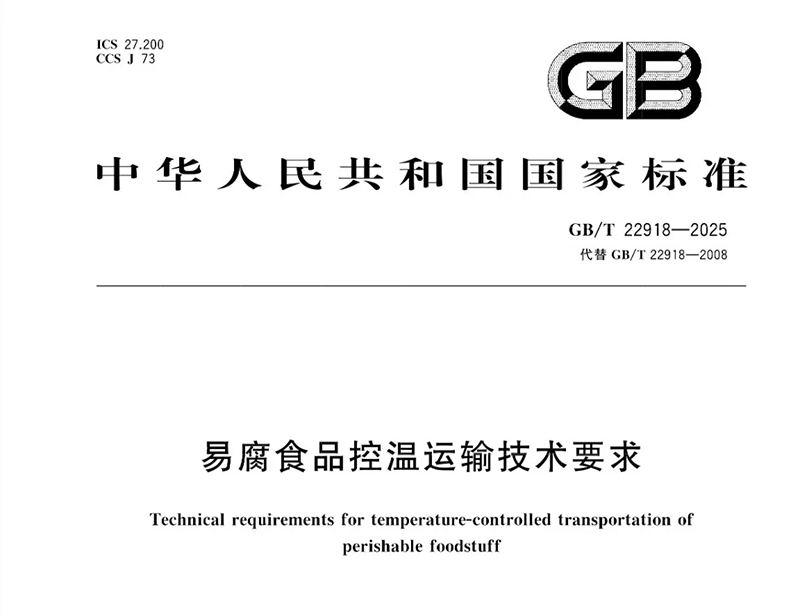
In 2026, the cold chain logistics and cold storage construction industry is entering a critical window of standard adjustment. With the official implementation of GB/T 22918-2025 “Technical Requirements for Temperature-Controlled Transportation of Perishable Food”, the long-used standards that had been in place for nearly 20 years are being fully replaced.

On the surface, this appears to be a routine update of technical standards. However, when placed within the broader cold chain supply chain system, its impact extends far beyond transportation. It is reshaping the entire industry’s operating model and management logic.

Within this transformation, the cold storage industry is also gradually entering a new phase — the strong-standard era.


01 / Moving away from “segment-based compliance”: cold chain is entering full-process continuous control

For a long time, the cold chain has operated in a segmented manner: cold storage is responsible for warehousing, refrigerated trucks are responsible for transportation, and the distribution end handles last-mile delivery. As long as each individual link met its own requirements, the entire process was considered complete. If no obvious issues were found at the time of delivery, the whole chain was regarded as compliant.

However, the signal conveyed by the new national standard is very clear: this “segment-based compliance” logic is being fundamentally redefined. The industry is now placing greater emphasis on full-process continuous control, rather than compliance at isolated points.

This shift has led to three very practical and fundamental changes:

From “result-oriented” to “process-oriented”

In the past, as long as the final product was not spoiled and temperature limits were not exceeded, the system was considered compliant. Today, results alone are no longer sufficient. The entire process must be explainable:
Was there any fluctuation in between?
Was there any break in the cold chain?
Is the data complete and traceable?

From “experience-driven” to “data-driven”

In traditional cold storage operations, experienced technicians played a crucial role—listening to equipment sounds, observing frost conditions, and judging return-air temperature differences. Today, such experience is gradually being replaced by system-based data. Real-time temperature monitoring, automatic recording, cloud data upload, and full-process traceability are becoming baseline capabilities of the industry.

From “point compliance” to “system compliance”

Cold storage, transportation, loading/unloading, and end distribution are no longer independent segments. If any single node fails, the compliance of the entire cold chain can be invalidated immediately.

In other words, the cold chain is shifting from a “segmented compliance system” to an integrated operational system.


02 / Redefining cold storage: three expanding core dimensions

As the starting point of the entire cold chain and the most critical stability node, cold storage is being redefined and pushed to a higher capability boundary under the new standards. The most direct impact can be observed in the following three aspects:

1. From “functional” to “must be stable”

In the past, as long as the cold storage could achieve cooling and normal dispatch of goods, the task was considered complete.
Today, however, the market places far greater emphasis on long-term operational stability.

Especially in complex scenarios involving high-frequency usage and multi-batch inbound and outbound operations, whether temperature fluctuations are controllable and whether the system can maintain stable long-term performance have become key evaluation criteria.


2. Energy consumption is becoming a core performance indicator

Previously, the industry focused mainly on cooling capacity.
Now, operational efficiency has become a critical concern.

For the same storage capacity and temperature requirement, some systems generate significantly higher electricity costs. At its core, this is an issue of system efficiency.

Against the backdrop of continuously rising lifecycle operating costs, differences in energy consumption are directly translating into differences in enterprise competitiveness.

3. System design capability is becoming a key industry dividing line

The gap in hardware equipment is gradually narrowing, but the gap in system integration capability is widening significantly.

Whether cooling load distribution is reasonable, whether different temperature zones operate in coordination, and whether the system has proper redundancy design are all becoming decisive factors in long-term performance.

It must be acknowledged that many structural weaknesses in cold storage facilities are not created during operation, but are already embedded at the design stage.

03 / Industry logic shift: from “project delivery” to “long-term operation”

If we summarize the current industry transformation in one sentence, it would be:

In the past, the competition was about whether it could be built; today, the competition is about whether it can operate stably over the long term.

Behind this lies a fundamental shift in the industry logic.
The cold storage industry is moving from one-time delivery to long-term operational management, and from pure equipment competition to system capability competition.

Cold storage is no longer just an engineering project; it is increasingly becoming a long-term operating energy system and management system.


04 / Dehezi’s practice: the true value of cold storage lies in every day of operation

In Dehezi’s project practice, this transformation is clearly and directly reflected.
We are increasingly convinced that the true value of cold storage does not lie at the moment of delivery, but in every single day of subsequent operation.

During the design phase of our projects, we typically focus on three key aspects:

Considering full lifecycle cost from the source

Cold storage is not only about construction cost; more importantly, it is about long-term operating cost.

If only initial investment is considered, long-term impacts such as electricity consumption, maintenance, and efficiency loss are often overlooked.

Therefore, at the design stage, we proactively incorporate structural heat loss, system matching efficiency, and operational costs into the overall evaluation framework.

Bringing energy optimization forward into system design

Energy saving is not something that can be “fixed” later through a single piece of equipment.
It is determined at the system architecture stage.

System design, piping layout, and cooling load distribution all directly affect final operational efficiency.

Our goal is not simply to reduce electricity costs, but to optimize overall efficiency while ensuring stable system operation.

Replacing experience dependence with systematic management

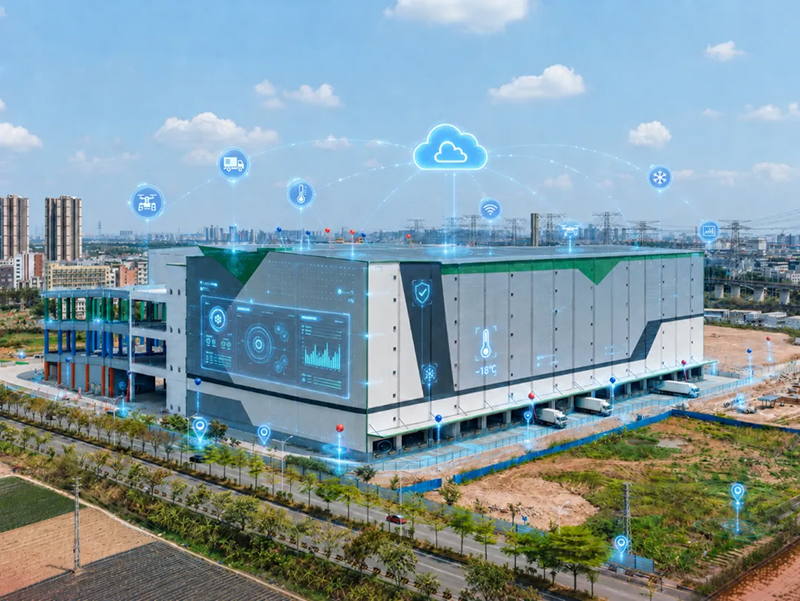
Through intelligent temperature control and digital systems, cold storage operations become more transparent and controllable.

Real-time monitoring, automatic alerts, data recording, and traceability enable the system to gradually shift from reliance on manual experience to automated system-based management.
05 / Conclusion: Advantage reshaping under new industry rules

Looking at the industry as a whole, the implementation of the 2026 new national standard is not simply a routine upgrade of rules.
It is more like a structural reorganization of the entire industry landscape.

The cold chain industry is shifting:

from extensive growth to refined operations;
from equipment competition to system capability competition;
and from one-time delivery models to long-term value creation models.

For enterprises with strong system design and engineering capabilities, this represents a window of opportunity to rebuild competitive advantages.
However, for participants still relying on traditional construction thinking and low-price competition, the industry entry barrier is steadily rising.

The transformation has already begun—and it continues to deepen.

Dehezi focuses on full lifecycle cold chain engineering solutions.
We serve industries including fresh produce, food, and pharmaceuticals, providing:

  • High-end refrigerated preservation cold storage
  • Precision controlled-atmosphere (CA) cold storage
  • GSP-compliant pharmaceutical cold storage

What we focus on is never just “building a cold storage facility,”
but ensuring stable and efficient long-term operation.

Through the deep integration of system-level design and intelligent temperature control technology, we help clients achieve:

  • 10%–30% reduction in operational energy consumption
  • 1–2× extension of product shelf life
  • Approximately 30% reduction in construction period