
EN


In the cold storage industry, we often hear clients ask: “How much does it cost to build a cold storage facility?”
In many people’s understanding, building a cold storage facility is simply about selecting brands, comparing prices, and assembling the system. However, the more projects we complete, the clearer one thing becomes: the early-stage solution defines the upper limit, while intelligent operations determine the final outcome.
What truly determines whether a cold storage facility performs well is not the day the equipment arrives on site, but the moment the design drawings are finalized.
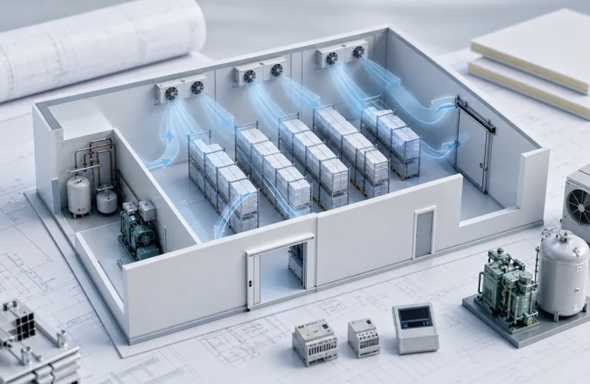
Many people see cold storage as simply a combination of equipment: compressors, air coolers, and insulated panels.
However, a truly efficient cold storage facility is a highly coordinated system engineering project.
“In cold chain engineering, equipment is only the execution terminal, while the solution is the core control center. Simply stacking high-performance equipment does not guarantee results. Without a scientific airflow model (air distribution design), or when feedback loops fail (temperature control deviation), the entire system can fall into ‘inefficient idle operation,’ where even the most powerful machines cannot deliver their intended performance.”
In the early-stage planning phase, what we need to address is far more than what to purchase. It includes:
Cooling capacity matching: Bigger is not always better. Excessive redundancy leads to high electricity costs and equipment wear.
Airflow organization: How high are the stacked goods? How wide are the aisles? Can cold air be evenly distributed to every corner?
Temperature difference control: During frequent door opening for inbound and outbound operations, how do we maintain stable temperature under high-frequency exchange?
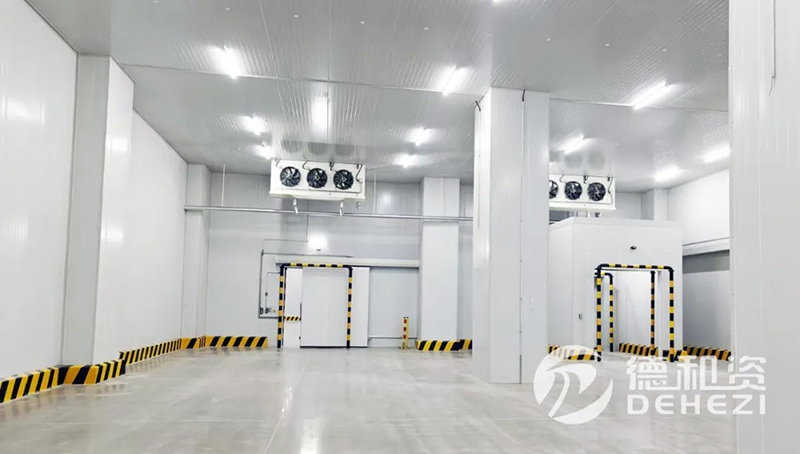
After on-site diagnosis, we usually find that the equipment is not faulty, and the brands are also reliable. The root cause is actually embedded in the design stage:
These issues are not “created” during operation—they are already “decided” during the design phase. Structural flaws are extremely costly to fix later, and retrofitting often costs several times more than the original construction investment.
Many clients focus on one-time capital investment in equipment. However, the real long-term cost comes from continuous “invisible losses” every single day:
“These costs usually remain in a management blind spot. Due to the lack of intuitive data support, it is difficult to detect declining system efficiency or abnormal energy consumption in time. This kind of ‘management gap’ gradually turns a cold storage facility from a high-quality asset into a hidden financial burden for the business.”
If we pursue a more direct and engineering-oriented expression, terms like “black box” can be replaced with more precise descriptions such as data discontinuity or management blind spots, which better reflect operational and financial realities.
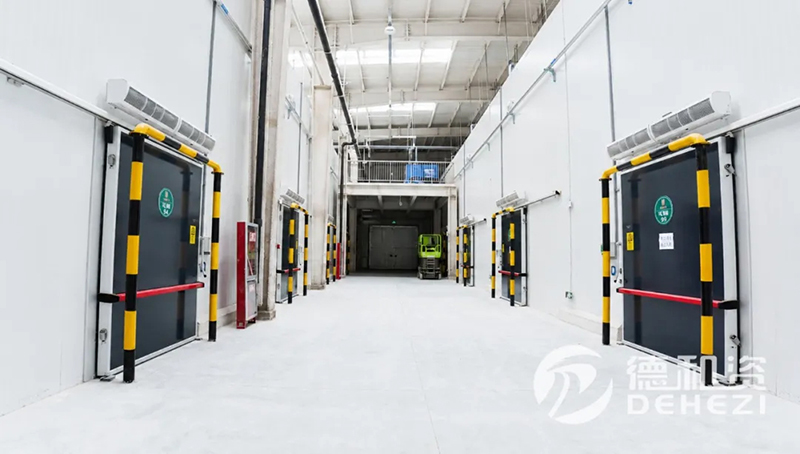
Intelligent systems are not simply an “expensive add-on” to equipment.
In essence, they bridge the data gap between manual management and equipment operation.
In the past, operators could only rely on experience to judge:
whether the cold storage was running properly, where the electricity cost was going, or whether there were hidden temperature risks.
Today, digital technologies turn these vague perceptions into precise, visible data:
Real-time visibility:
In the past, you only knew whether it was cold after entering the warehouse. Now, with a mobile device, operating load, real-time temperature, and humidity are all clearly visible.
Early warning mechanism:
Before actual product loss occurs, the system can automatically detect anomalies within the critical “golden window” and issue alerts—shifting from “post-event correction” to “prevention in advance.”
Remote control:
Managers no longer need to stay on-site 24/7. Wherever they are, the operational logic of the cold storage system remains fully under control.
Some clients may ask: “Is it okay if we don’t implement intelligent systems now?”
Our answer is straightforward—short-term, yes; long-term, it will become increasingly passive. The reason is not complex, but rather driven by several inevitable industry trends:
Cold storage facilities are becoming larger, with more sites and more distribution points, while the workforce does not grow at the same pace. Traditional experience-based, manpower-driven management is difficult to maintain stability in multi-warehouse and multi-scenario operations.
Electricity, labor, and product loss costs are all increasing. The room for absorbing inefficiencies in rough management is shrinking rapidly. Only refined, data-driven operations can preserve profitability.
Especially in industries such as food and pharmaceuticals, requirements for temperature stability, data recording, and process traceability are no longer “value-added features,” but mandatory entry standards.
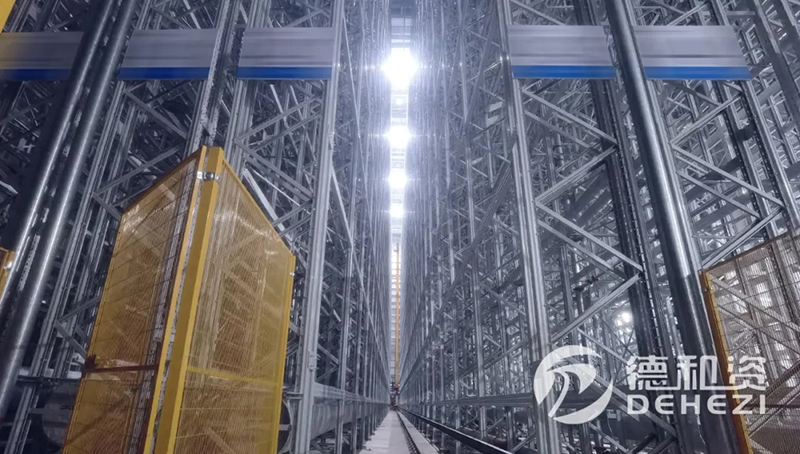
The cold storage industry is entering a new phase:
from “competing in construction” to “competing in operations”, and from “relying on experience” to “relying on data.”
At its core, this transformation is driven by two key factors:
Early-stage planning determines the upper limit
It defines the structural logic of the system, its energy efficiency boundaries, and the potential ceiling for future optimization.
Intelligent systems determine the operational floor
They ensure that the cold storage facility remains stable and controllable over long-term operation, preventing instability caused by human variability.
This is why we repeatedly refine the design in the early stage—carefully validating usage scenarios, product characteristics, and operational models—and why we insist on integrating intelligence into the overall design.
Not to increase complexity, but to eliminate uncertainty as early as possible.
Because the true value of cold storage is never defined at the moment of construction completion,
but in every single day that follows.
Stable operation, controllable energy consumption, and predictable management—these are the true long-term value of a cold storage facility.


